Integrate product relations
Once you have created relations in Data Platform, you can use them in Visual Configurators and Search Studio search results.
Use relations in a configurator
Compatible relations let you bundle products across configurator sections, guiding shoppers to the right combination of products.
Depending on your account setup, you can create a configurator either in Conversation Studio or in the standalone Configuration Studio. In either case, the steps are the same.
- Open an existing configurator or create a new one.
- In the
Catalogtab, link a Data Platform project and select catalogs for the configurator. - Go to the
Composetab to create or manage the sections. Create one section per product type and connect each section to the corresponding catalog in Data Platform.
Make sure your configurator has at least two sections before enabling relations.
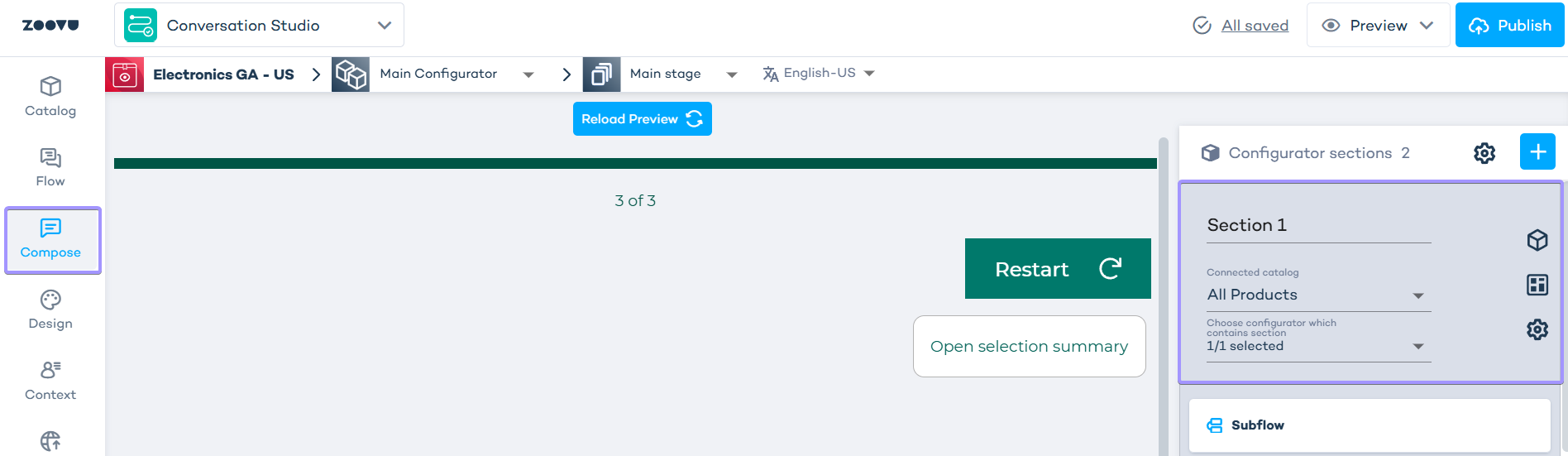
- In each section's settings, click on the cube icon to open compatibility settings.
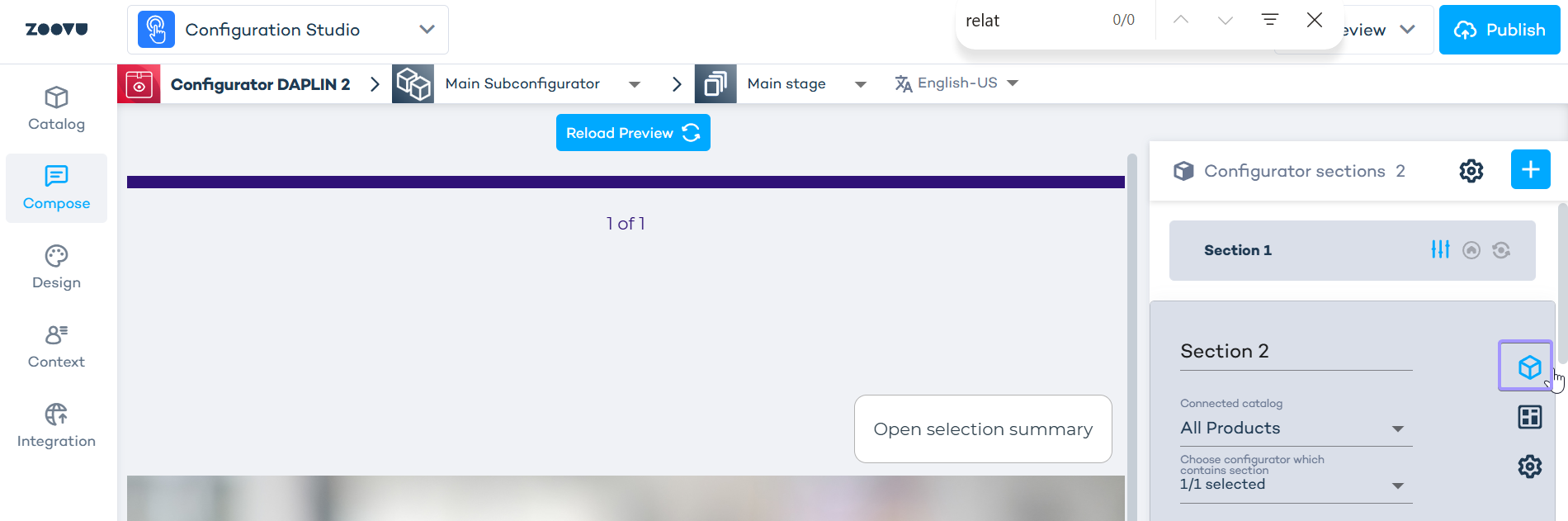
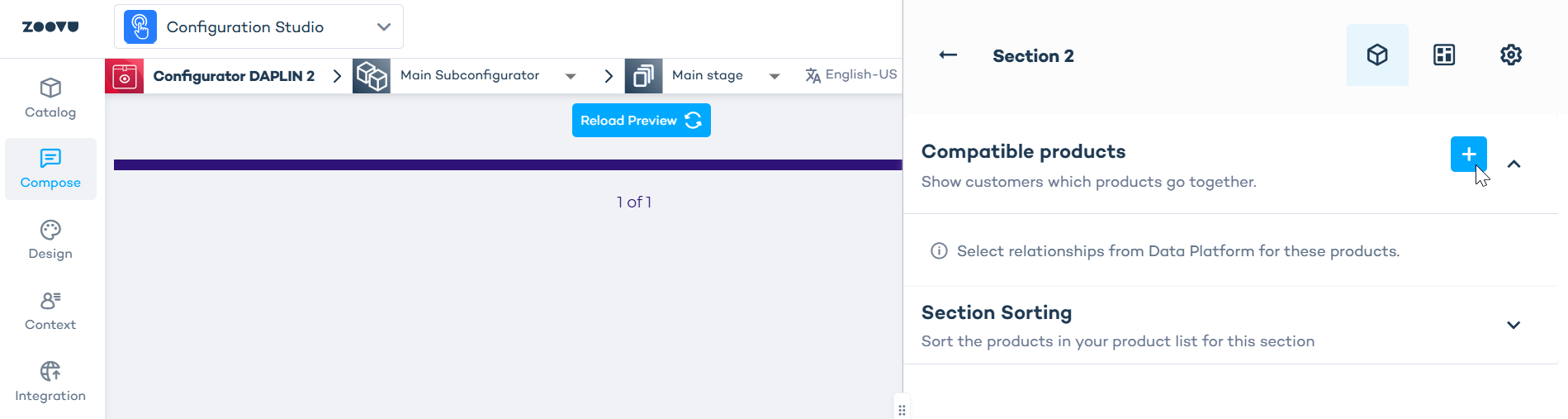
- Click the
+icon.
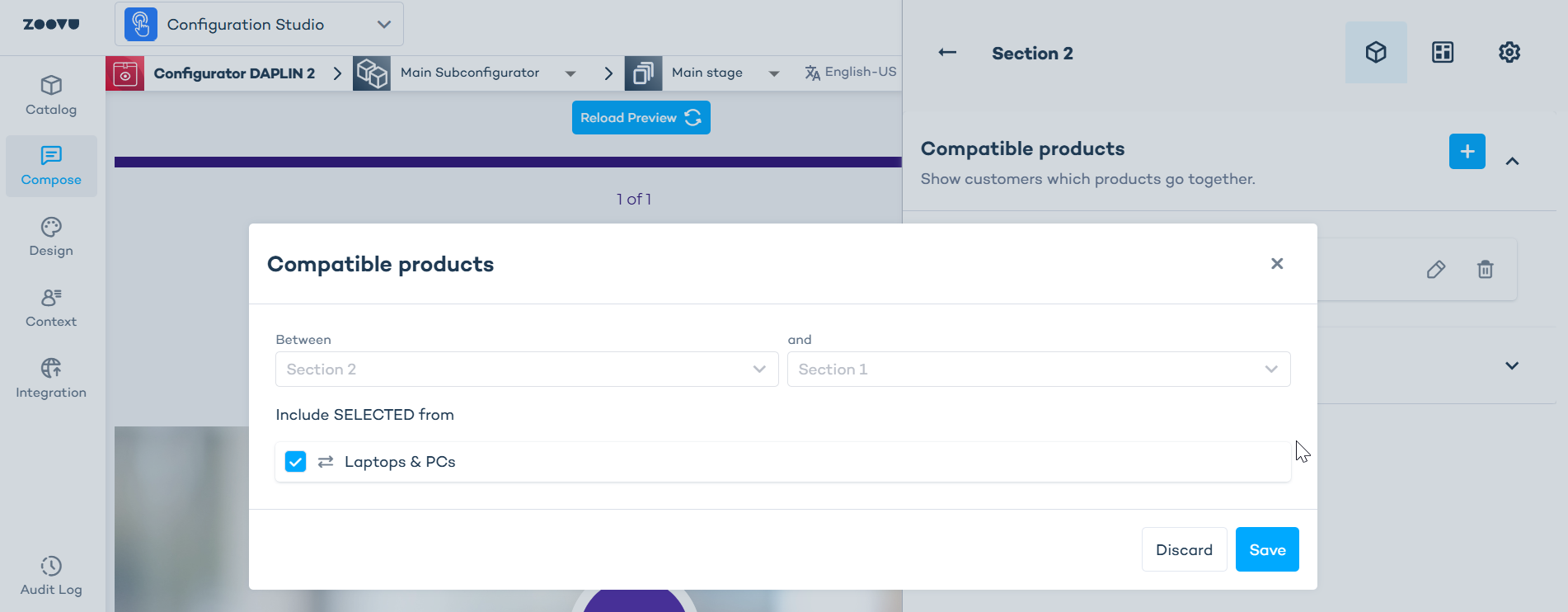
- When a modal opens showing all relations created in Data Platform for the linked project, select the sections you want to connect and choose a compatibility relation.
Adding multiple compatibility rules between two sections
If you need more than one compatibility rule between the same two sections, edit the existing relation rather than creating a new one.
In the example below, there are two existing relations: Actuators to Results and Actuators to Assembly.
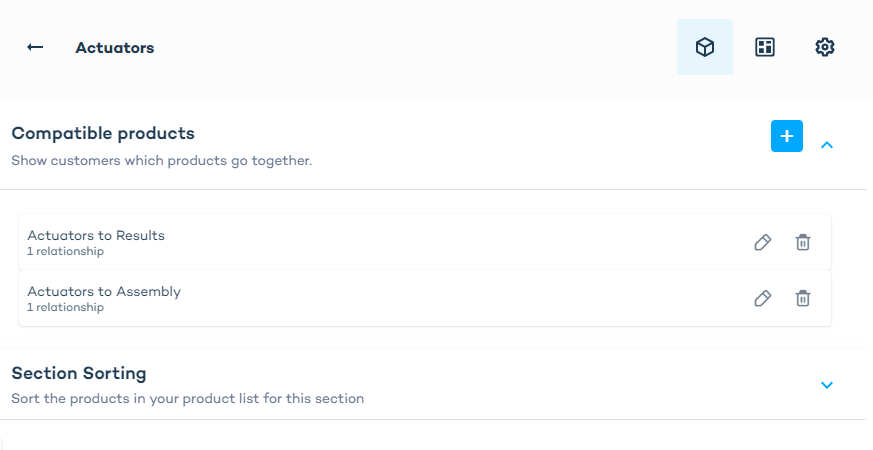
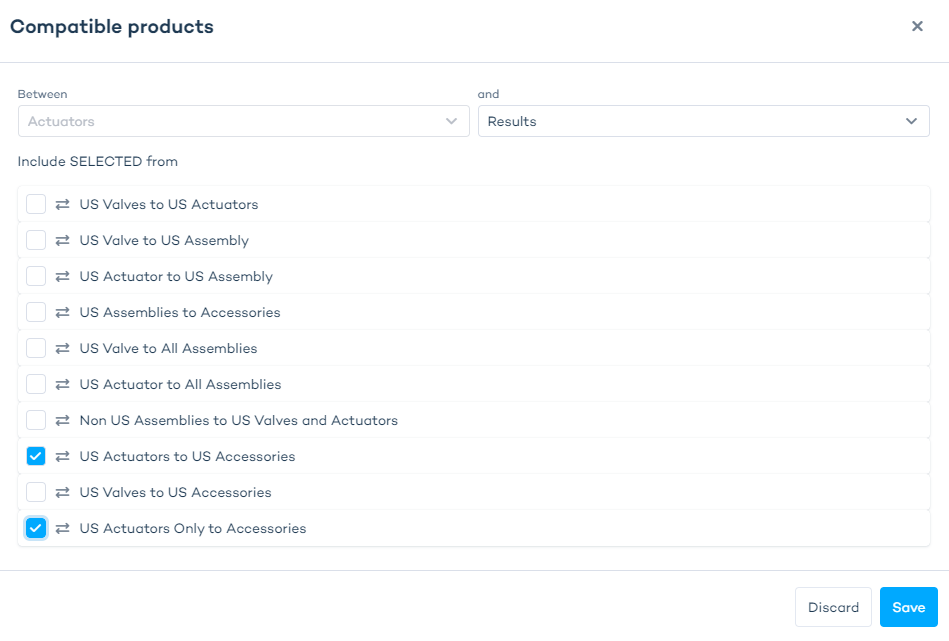
To add another rule, open the existing relation between those sections and add the new compatibility rule there.
Bundle Assistants
-
In Conversation Studio, add a Results Page to your question flow.
-
Select the Results Page, then open the results page settings by clicking the shopping cart icon.
-
Add Product bundles.
-
Select the primary and secondary catalogs you want to use in the bundle.
-
Link each selected catalog to the matching catalog from Data Platform using the dropdown selectors.
-
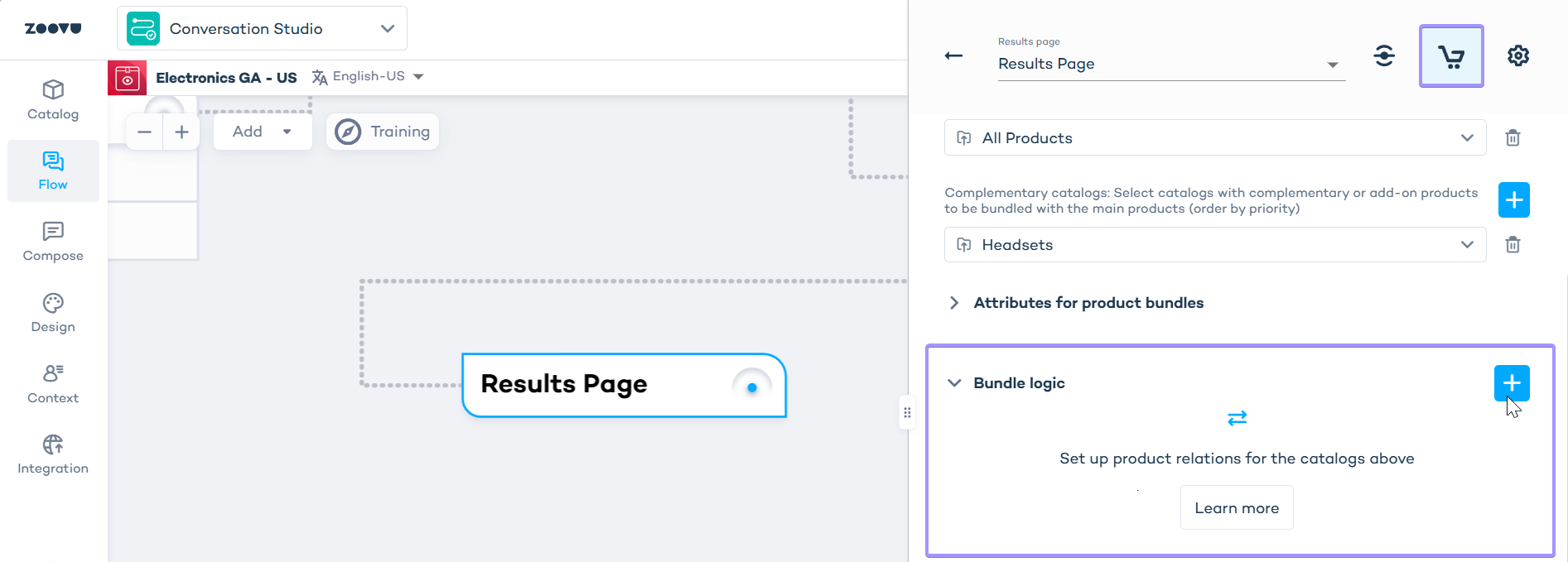
Scroll to Bundle logic and click the plus button.
-
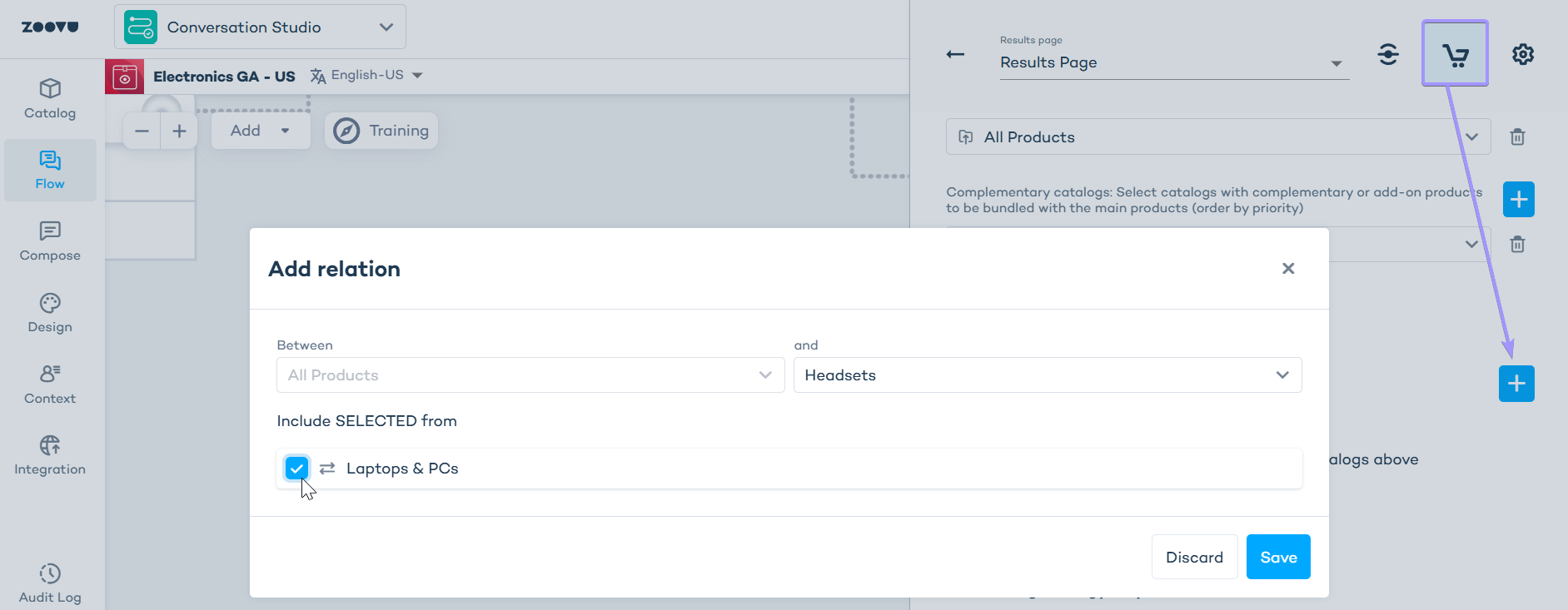
In the Add relation window, choose the source and target catalogs in the Between and and fields.
-
Select the relation you want to use. The available relations come from the relations configured in Data Platform.
-
Click Save.
Accessories display in bundle assistants
When a bundle assistant returns related products for more than one top product, accessories appear in sequential groups on the results page. All accessories for the first top product are shown together, followed by all accessories for the second top product.
For example, if your assistant recommends two products (one in matte black and one in stainless) all matte black accessories appear first, then all stainless accessories. The two sets are not mixed together. The grouped display makes it clear to the user which accessories belong to which product.
If your use case requires a different display order, raise it with your implementation team.
Use relations in Search Studio
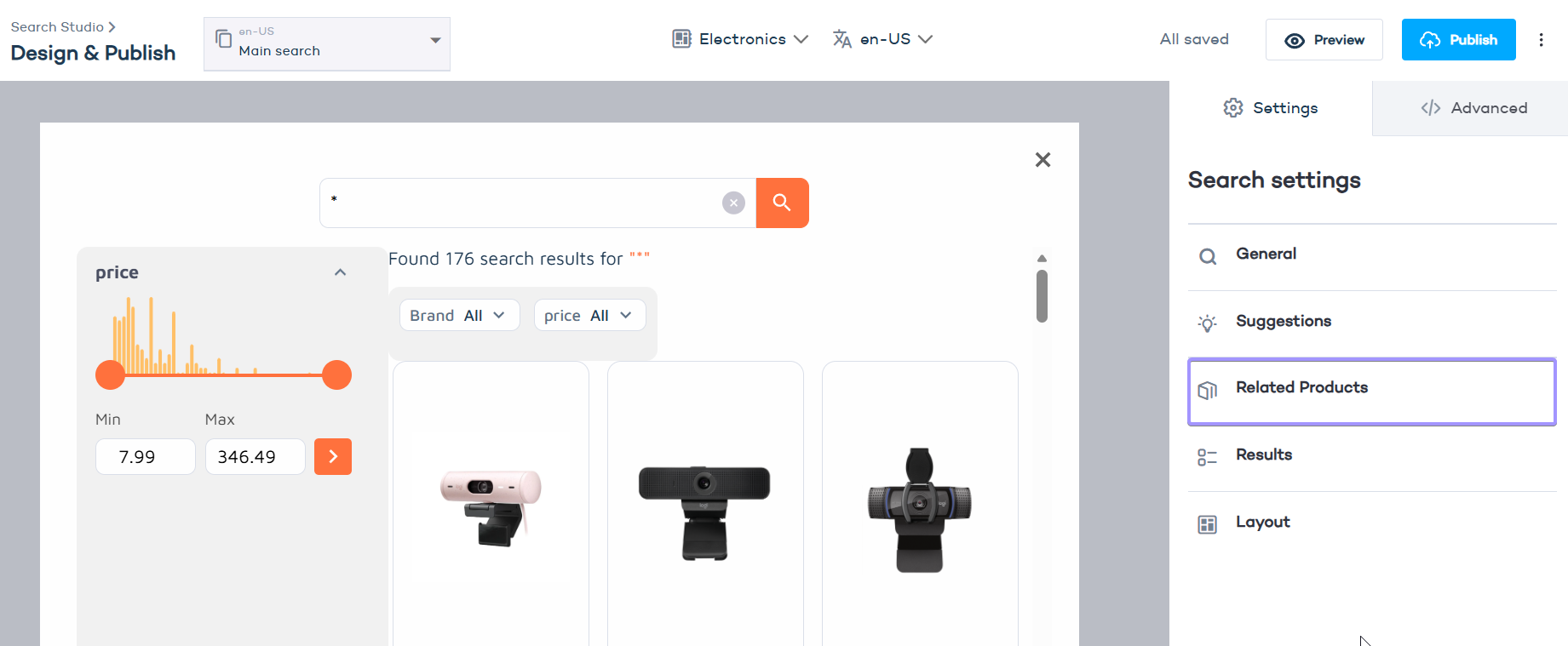
- Go to Search Studio > Design & Publish.
- In the settings menu, open Related Products.
- Enable the Activate toggle.
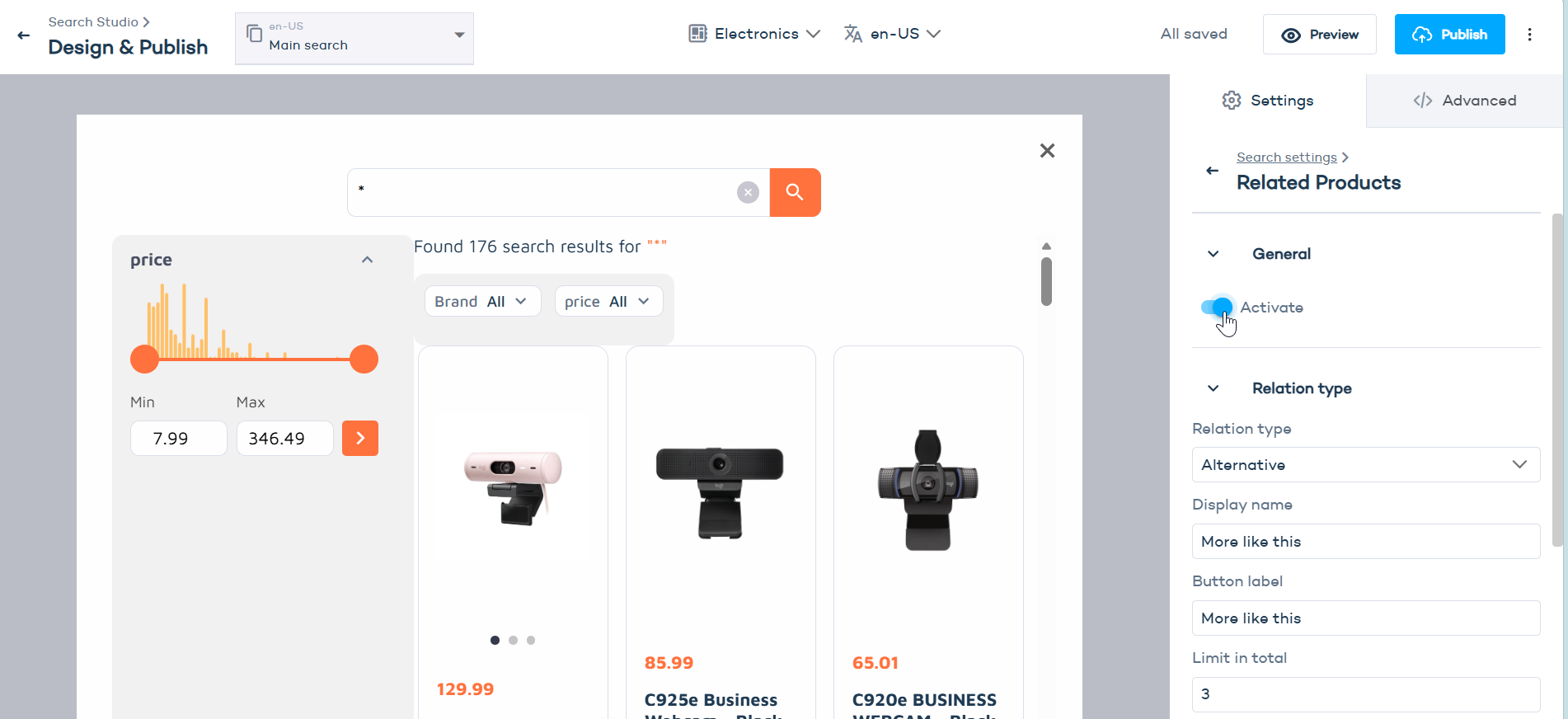
- Select the relation type: Alternative or Compatible.
- Enter the text to display above the recommended products (e.g. "You may also like...").
- Set the total limit for relations (e.g. 2 relations of the Alternative type) and the limit per relation (e.g. 1 item per relation).
- Style the layout and results section using the options below.
In search results, the main recommended products come from the left-side set in your relation, and the alternatives shown below come from the right-side set.
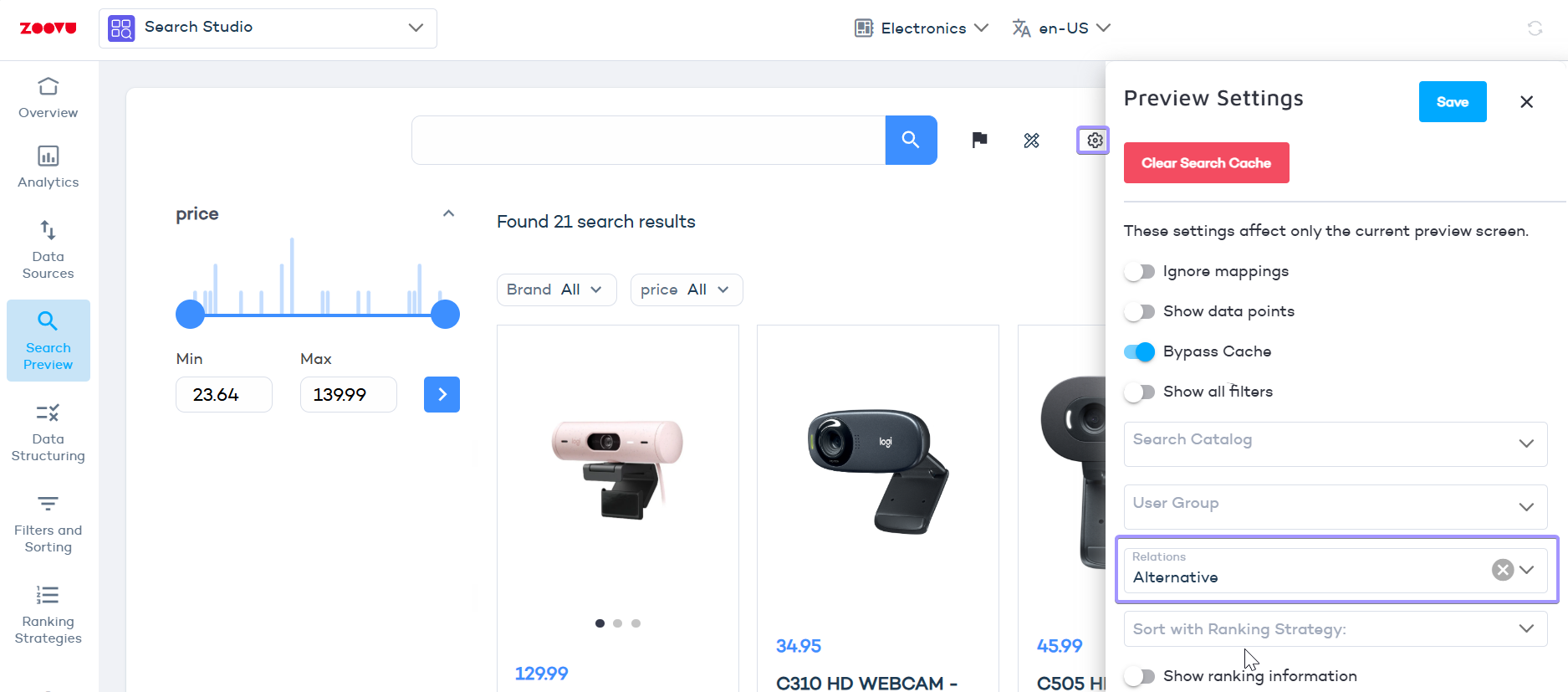
- Go to Search Studio > Search Preview and search for a product from your catalog to verify the output.
- Open Search Preview Settings and check the Relations section.
To style product relations on your assistant's Results Page, use Experience Designer. Learn more.
Relations in Zoe
To enable relations in Zoe, go to Advisor Studio > Zoe > Editor > Capabilities. Learn more.
Every relation carries a tag (relation type), for example Compatible, Accessory, Replacement, or a custom name your team defined. Tags are how you control which relations show up where.
- Zoe defaults to the
Compatibletag. If you enable the Relations tool in Zoe and don't pick specific relations, Zoe pulls everything taggedCompatible. - Search Studio lets you target any tag or specific relation ID through
includeTagorincludeRelationsettings.
If your team uses a tag other than Compatible for accessories, you need to explicitly select it in Zoe. Otherwise Zoe won't surface it.
For Zoe's "suggested alternatives" behavior specifically, both compatible relations and search vector need to be enabled. Missing either one is a common cause of Zoe not suggesting alternatives.
What this looks like to a user:
A customer asks Zoe "What do I need with this?" or similar. Zoe recognizes the intent, calls the relations tool with the product SKU, and returns products from the relevant tag.
Relations in Search Studio (search plugin)
Relations setting in the search plugin config controls the relations CTA on result cards and how related products display: inline, drawer or layover.
| Parameter | What it controls |
|---|---|
includeTag | Show only relations of one type. Format: {tag: 'relation type name', limitPerRelation: 2} |
includeRelation | Show one specific relation by ID. Format: {id: 42478} |
layoutType | grid or list |
resultStyle | plain or card |
drawerPosition | left or right, if using drawer display |
emptyStateTitle / emptyStateText | What shows if no related content resolves |
Use includeTag when you want one category of relation surfaced (for example, only Accessory). Use includeRelation when you want to pin a specific product-to-product relation regardless of tag.
Troubleshooting
| Symptom | Likely cause |
|---|---|
| Zoe never suggests related products | Relations tool is off, or no relations are tagged Compatible (and none were manually selected) |
| Zoe suggests accessories but not alternatives | Search vector isn't enabled alongside compatible relations |
| Search Studio shows no related products | RELATIONS feature flag off, or the tag in includeTag doesn't match any tag used in Data Platform |
| Wrong products showing as related | Wrong tag targeted, check includeTag or Zoe's relation selection against what's actually tagged in Data Platform |