Feeding document knowledge to Zoe RAG
Zoe uses information from your documents to improve the accuracy of its answers. You can add document-based knowledge in two ways, depending on what the documents describe:
- AI Knowledge Index – best for general information that applies to all products or your brand.
- Product facts – best for product-specific documents, such as user manuals or data sheets linked to individual items.
Both paths can be used together.
Crawl documents into the AI Knowledge Index
Use this option when the documents contain general product or brand information that should be available to Zoe across the catalog.
- In Data Platform, go to Pipelines and create a crawler.
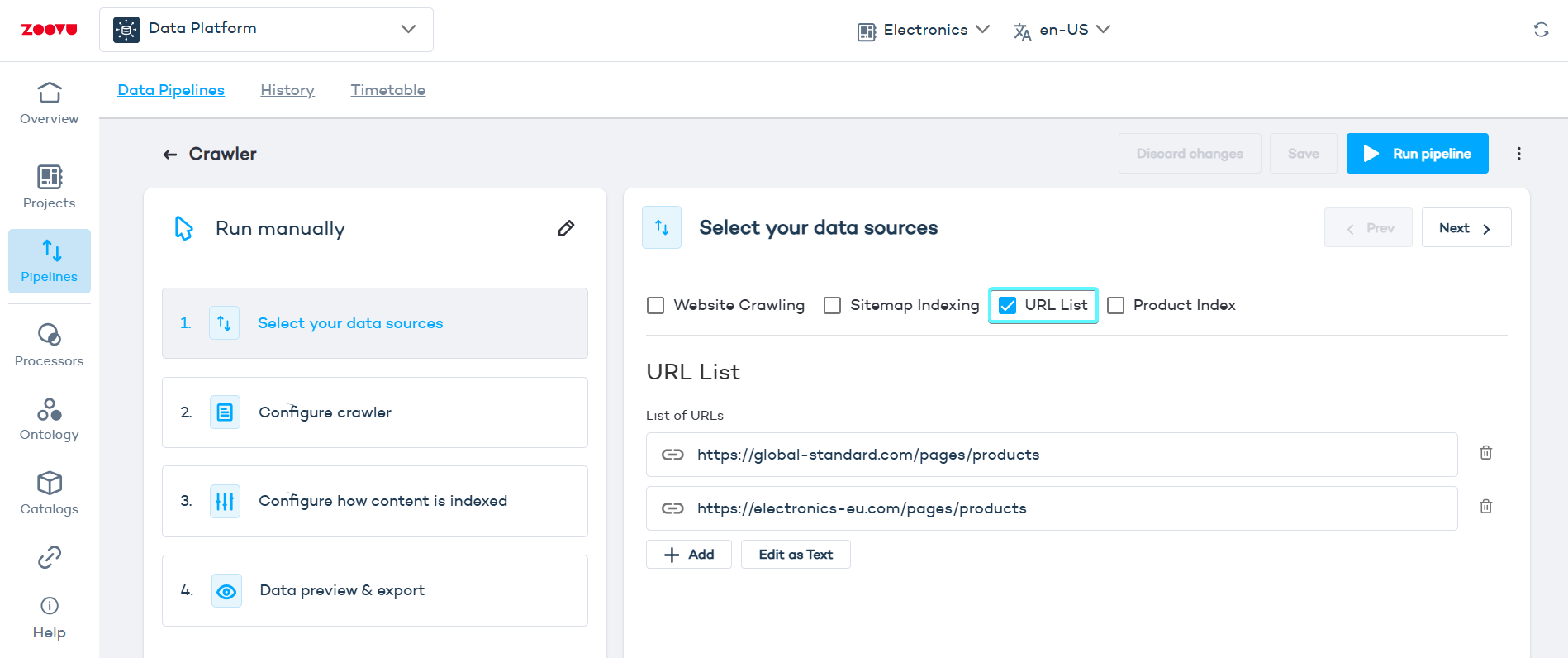
- Under Data sources, select
URL listand enter the links to your content pages.
- In Data preview & export, select AI Knowledge Index as the use case.
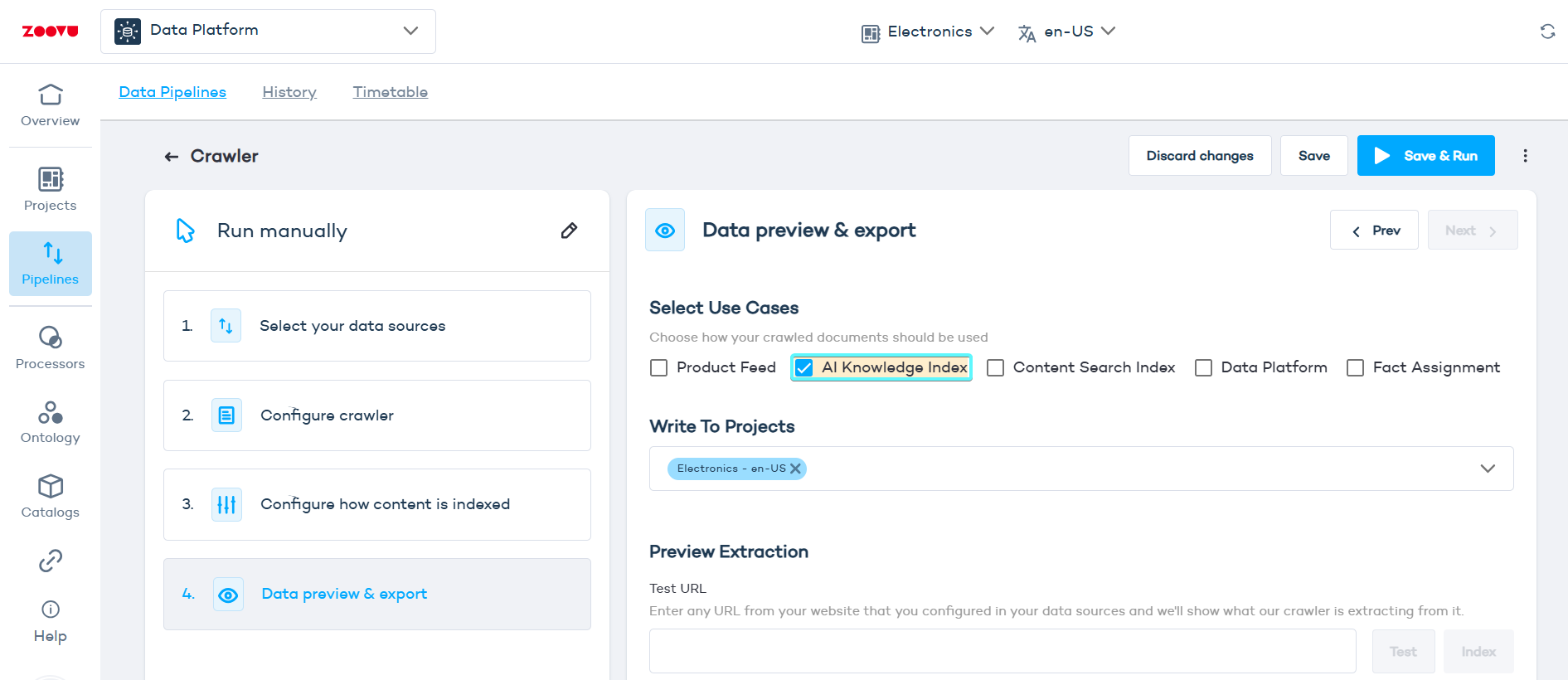
Zoe will learn from these documents to provide general answers about your products and categories.
Crawl documents as product facts
Use this method for product‑specific documents, such as user manuals or specification sheets. Zoe connects the content of each document to the corresponding product.
- In Data Platform, create a crawler pipeline using your product feed (with valid product detail page URLs) as the data source. Select
Product Index:
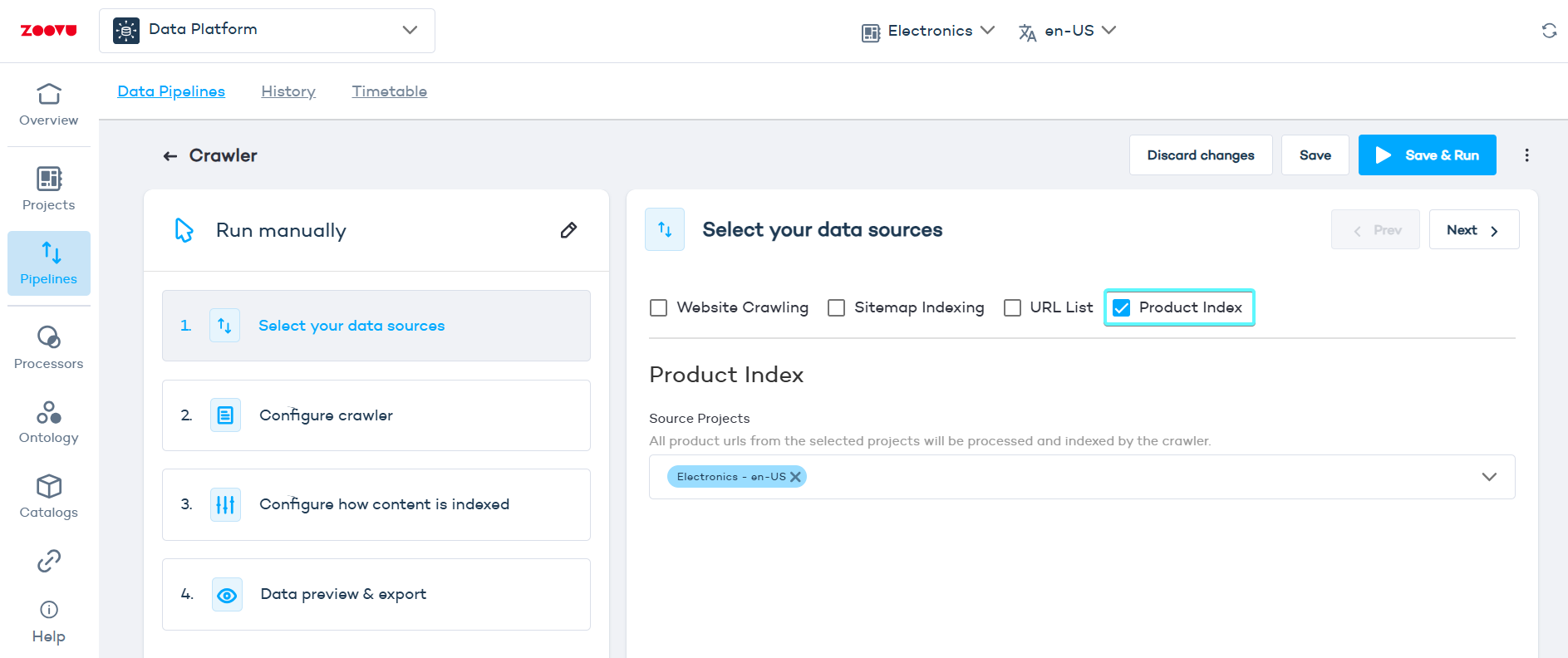
- Optional: You can limit the crawl to specific catalogs.
Defining document data points for RAG
For the RAG use case, you only need to define document data points. In most cases, you don’t have to change your crawler setup. Document data points work like regular ones but include an option to identify product documents.
- In the crawler configuration, go to Step 3: Configure how content is indexed.
- Create a data point and edit it.
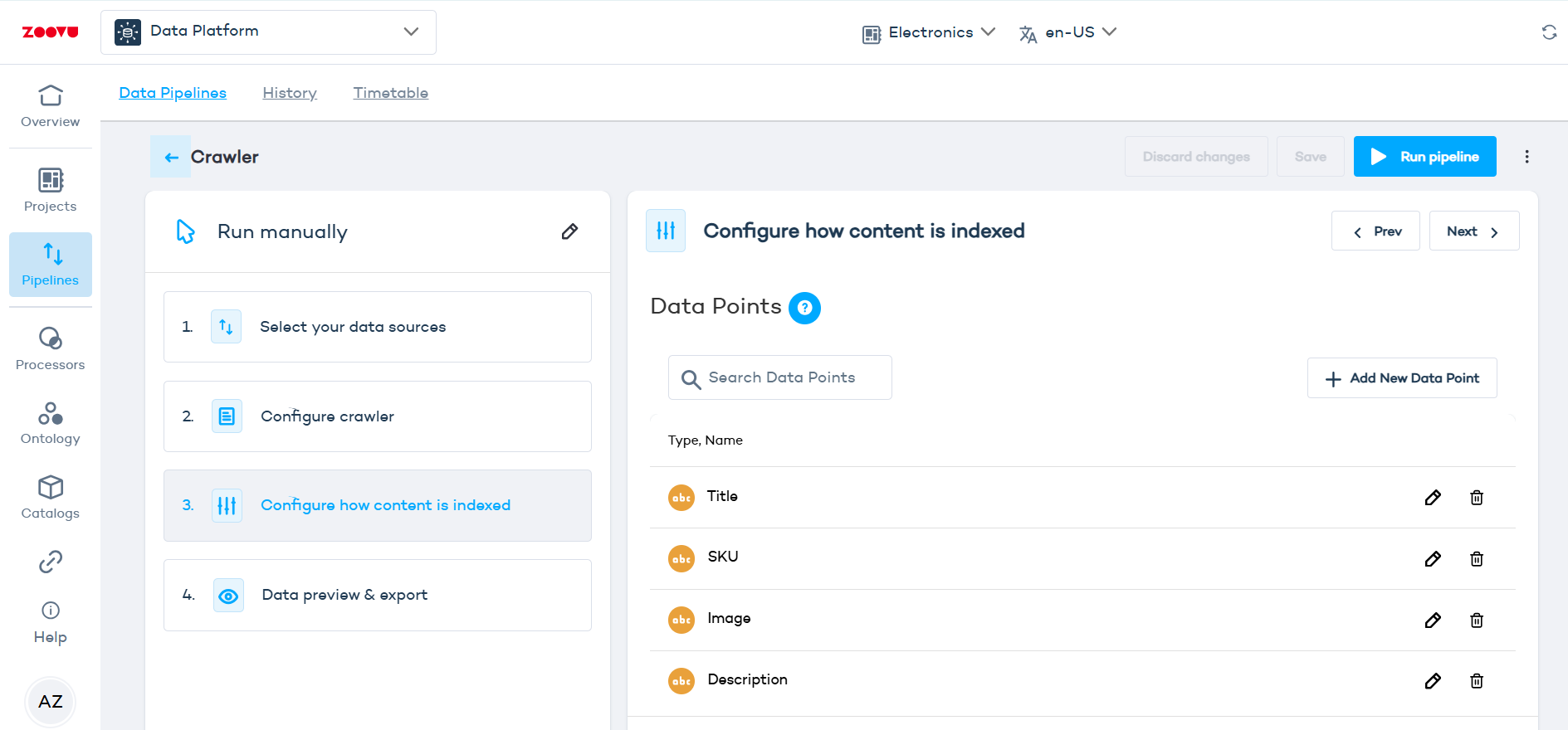
- Under Set as, choose Product document URLs to tell the system that this data point contains links to product documents.
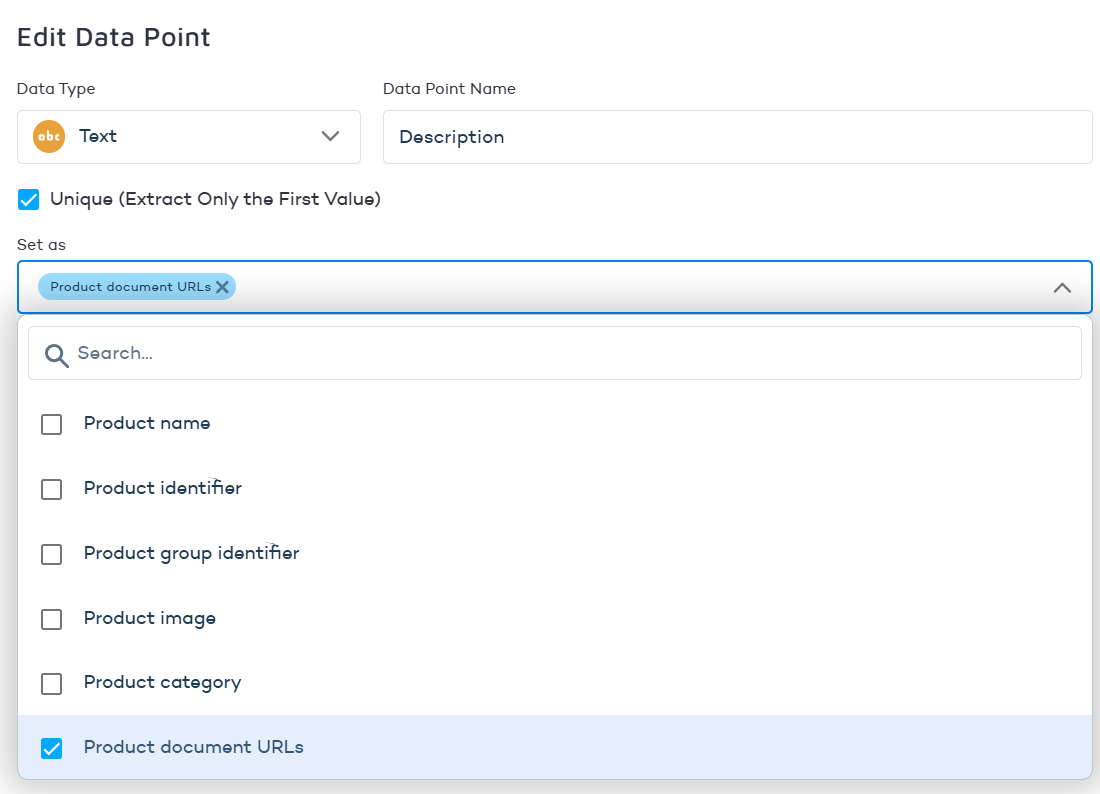
- Select how the crawler should extract the document links: XPath, URL pattern, Linked Data, PDF Meta Data, or Content Regex.
- If you use XPath, enter a rule that points to the correct document link on the product page.
After you define the data point, the crawler collects document URLs for each product. When processing finishes, the documents appear in Assigned Facts and Zoe can use their content in conversations.
Processing time varies depending on the number and size of the files. The documents appear in Zoe after indexing is finished.
Category documents for Zoe
You can attach document URLs to category concepts. Zoe uses these documents as shared knowledge for all products in the category.
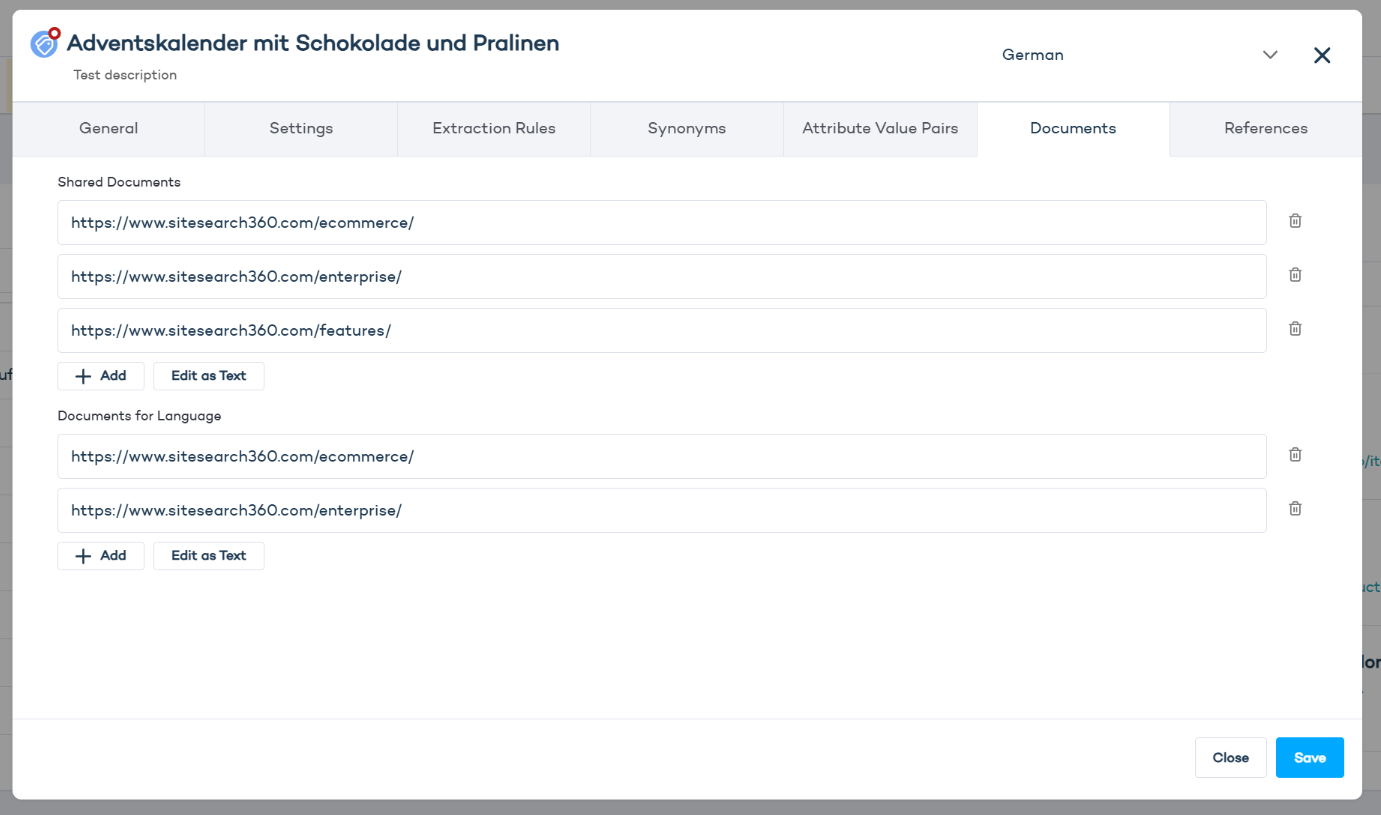
This solution is useful when information applies to many products, e.g. category-level FAQs. Products automatically inherit this knowledge, so you do not need to attach the same document to each product.
Manage documents in the AI Knowledge Base
You can view and manage the entire knowledge base index directly in Data Platform, under AI Knowledge Base. This gives you a single place to review the documents Zoe uses and to add, update, or remove them without re-running a crawler.
From here you can also create and edit Conditional Documents – documents assigned to all products that match specific filter conditions (such as brand or product line). Only products that meet all selected conditions receive the document(s).
Enable document‑based answers in Zoe
To allow Zoe to use information from product documents:
-
Enable the following feature flags:
- Advisor Studio
- Zoovu Ontology Expert
- Zoovu Ontology Expert (alpha)
-
In Advanced configuration, add this parameter (booleans, not strings):
{"AI_CONTENT_RETRIEVER":{"enabled":"true", "enableCitations":true}}
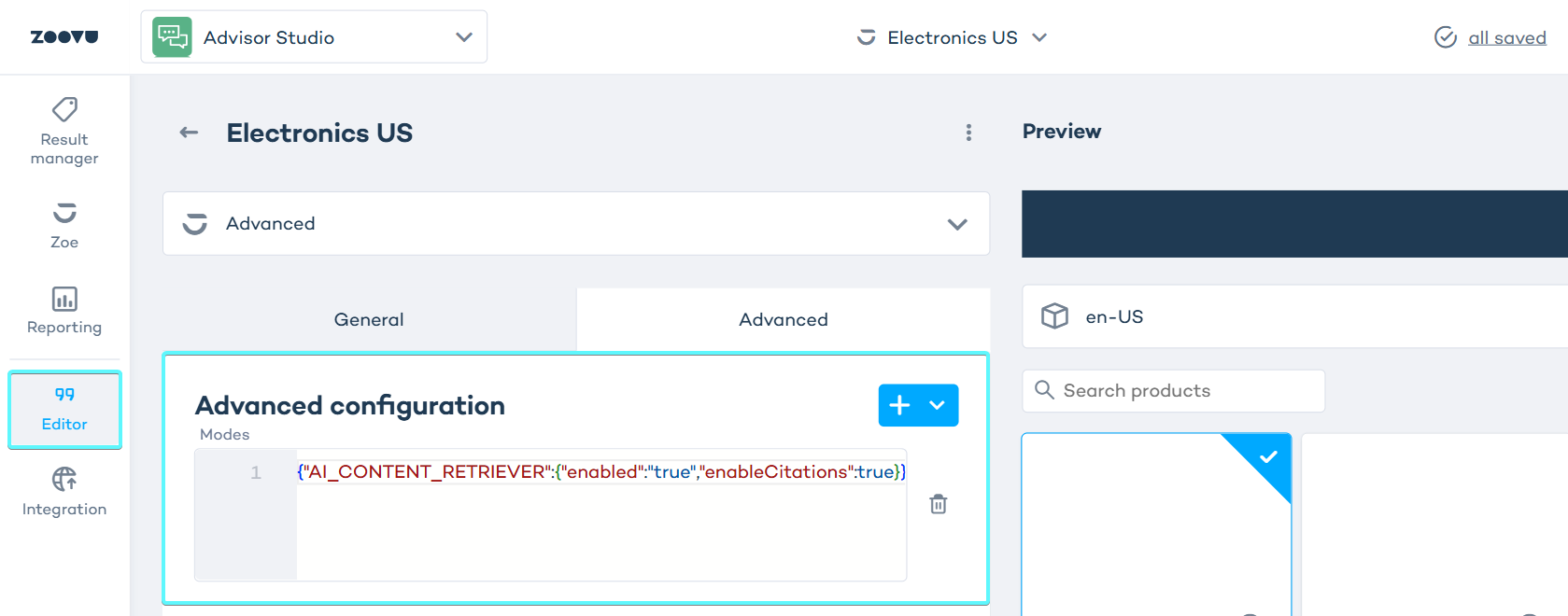
Zoe can now access and cite relevant document content during conversations.
Manually indexing URLs
In addition to adding documents through Pipelines (crawling) or the API, you can index individual URLs from the Data Platform UI (no pipeline required). This is useful when you want to add a single document quickly or when the source is not part of a crawled site.
In Data Platform, go to Documents > AI Knowledge Base. This view lists all indexed URLs and shows whether each document is classified as:
- general knowledge,
- product-specific, or
- category-specific.

Indexing a new URL
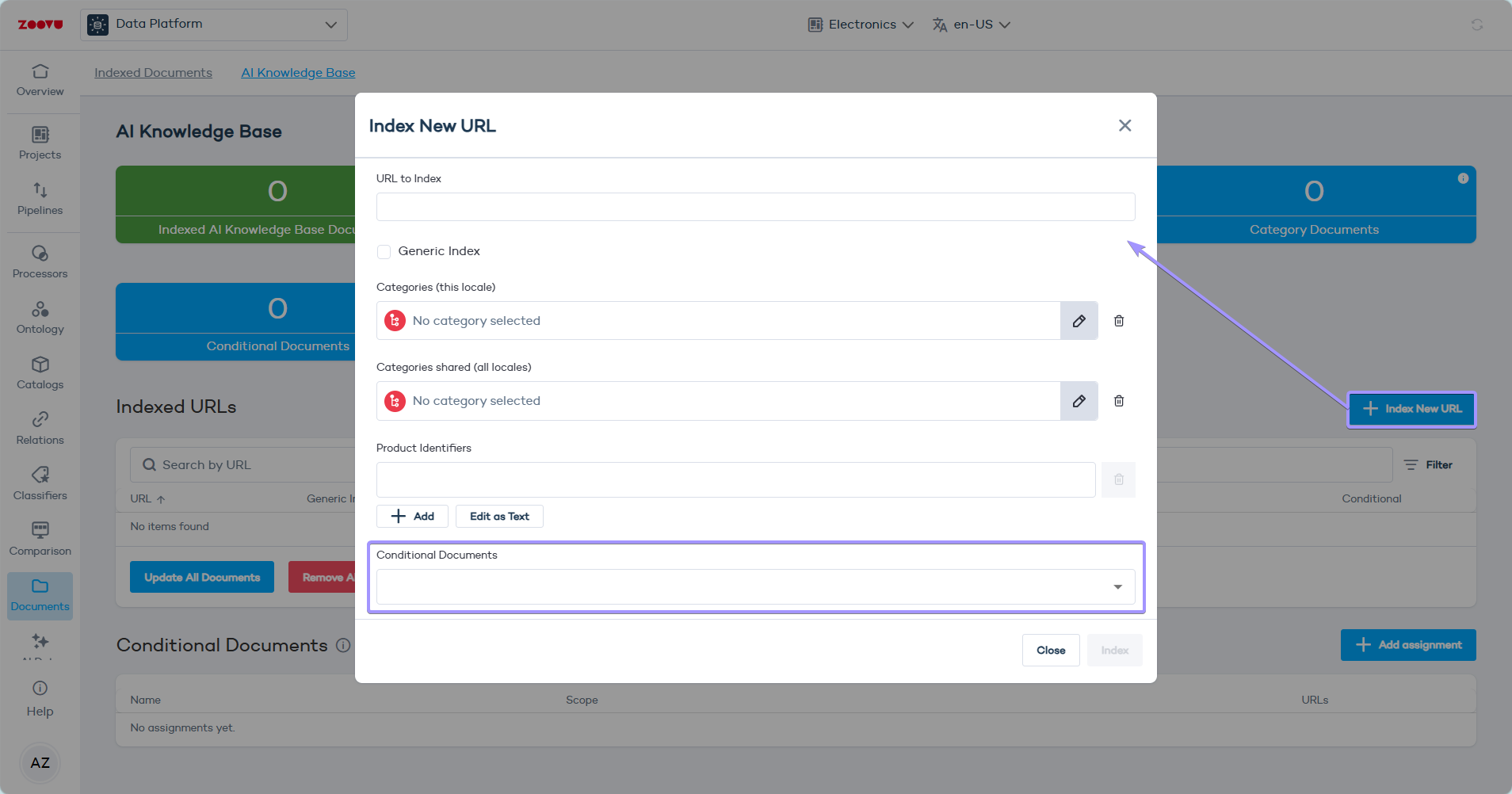
To add a new URL manually, click + Index New URL.
Only one assignment type is required. Leave the others empty if they don't apply.
| Setting | What it does |
|---|---|
| URL to Index | The URL of the document you want to index. |
| Generic Index | Check this to add the document as general knowledge. It's available to Zoe across all products. |
| Categories (this locale) | Attach the document to all products in a selected category, for the current locale only. |
| Categories shared (all locales) | Attach the document to all products in a selected category, across every locale. |
| Product Identifiers | Attach the document to specific products by entering their identifiers. Use + Add to add entries one by one, or Edit as Text to paste a list. |
| Conditional Documents | Select an existing conditional document rule to apply this URL to the products matching that rule. |
Click Index to submit. The document will be processed and appear in the AI Knowledge Base list once indexing is complete.
Conditional Documents
Conditional Documents let you assign one or more URLs to products that match a specific combination of attribute filters. Documents are only surfaced for products that meet all conditions in the rule.
When creating or editing a conditional document rule, you define:
- Name — a label for the rule (e.g. "Bosch Dishwasher Brochure").
- Scope — whether the rule applies to this locale or is shared across all locales.
- URLs — one or more document URLs to include in this rule.
- Filters — attribute conditions that a product must satisfy. Each filter specifies an attribute (e.g. Brand), an operator (e.g. equals to), and a value (e.g. Bosch). Add multiple filters with + Add filter; all conditions must be met (IF ALL logic).
- Then — the action applied to matched products (default: Set to include).
A live product count on the right side of the modal updates as you configure filters, so you can verify which products will be affected before saving.
Example: A rule with Brand = Bosch AND Category = Dishwashers will attach the linked brochure to every product that is both a Bosch product and belongs to the Dishwashers category.
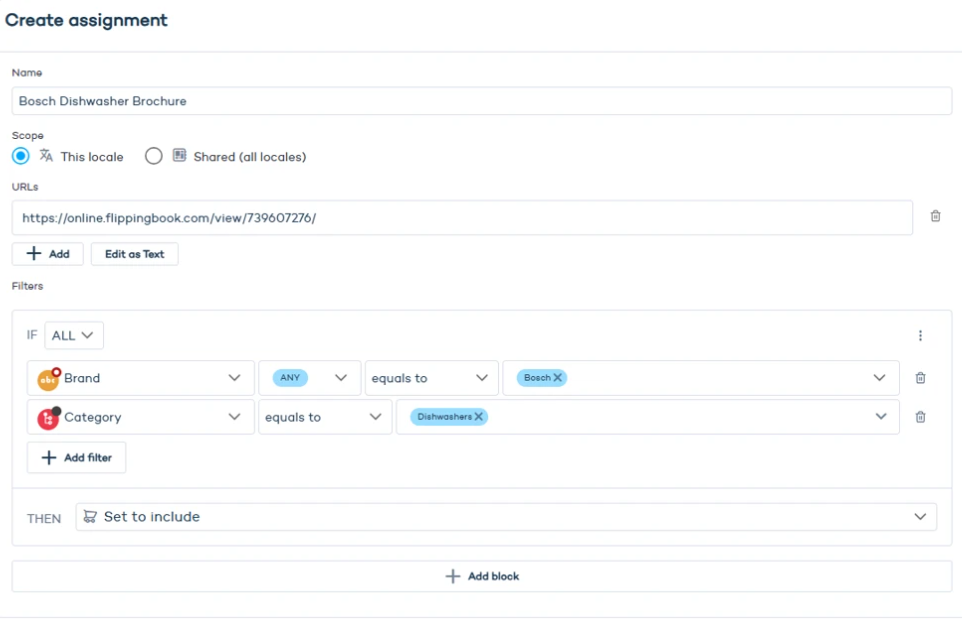
Use + Add block to layer additional filter groups within the same rule.
Choosing the right assignment type
| If you want to… | Use… |
|---|---|
| Make a document available to Zoe for any question | Generic Index |
| Attach a document to an entire product category | Categories (this locale or all locales) |
| Attach a document to a handful of specific products | Product Identifiers |
| Attach a document based on attribute logic (brand, product line etc.) | Conditional Documents |